Scientific Indiana by Duane S. Nickell
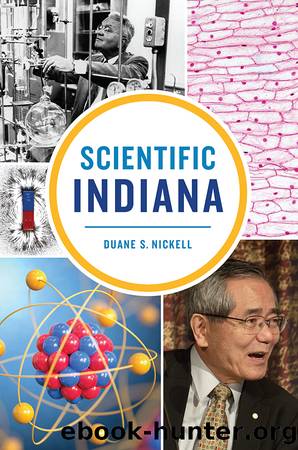
Author:Duane S. Nickell [Nickell, Duane S.]
Language: eng
Format: epub
Tags: History, United States, State & Local, General
ISBN: 9781467149488
Google: zsIqEAAAQBAJ
Publisher: Arcadia Publishing
Published: 2021-06-15T02:40:43+00:00
Postage stamp commemorating Percy Julian. Shutterstock.
In April 1975, a week after his seventy-sixth birthday, Percy Julian died of cancer. He is buried in Elm Lawn Cemetery in Elmhurst, Illinois.
8
WENDELL STANLEY
1904â1971
Field | Biochemistry
Major Contribution | Won the Nobel Prize for Chemistry in 1946 for his work on viruses
Indiana Connection | Born in Ridgeville and graduated from Earlham College
The viruses hold the key to the modificationâfor better or worseâof all life. They hold the key to the secret of life, to the solution of the cancer problem, to biological evolution, to the understanding and control of heredity, perhaps to the nature of all future life on earth.
âStanley in 1956, quoted in his New York Times obituary
WENDELL MEREDITH STANLEY was born in Ridgeville, a small town in east-central Indiana, on August 16, 1904. His parents, James Stanley and Claire Plessinger, published two local newspapers, the Ridgeville News and the Union City Eagle. When James died in 1920, the family moved to Richmond. Wendell graduated from Richmond High School in 1922 and enrolled at Earlham College, also in Richmond, where a family ancestor had donated land for the college with the provision that anyone bearing the Stanley family name would be given special consideration. Stanley majored in chemistry and mathematics and was captain of the football team. After earning his degree in 1926, his plan was to become a football coach, but after meeting with Roger Adams, head of the chemistry department at the University of Illinois, he changed his mind.
He began graduate work in organic chemistry at Illinois, where he earned his doctorate in 1929. He married Marian Staples shortly after graduating on June 15, 1929. The couple eventually had four children, a son and three daughters. Stanley stayed at Illinois for another year as a postdoctoral research assistant, then left as a National Research Council Fellow to do research in Munich, Germany, with Heinrich Wieland, a Nobel laureate in chemistry. In late 1931, he returned to the United States and accepted a position as an assistant at the Rockefeller Institute for Medical Research in New York City. In 1932, Stanley transferred to the instituteâs Department of Plant and Animal Pathology, located in Princeton, New Jersey. It was there that Stanley was introduced to the field of virology, where he would do his most important work.
At the time, scientists were baffled by viruses. They were known to cause contagious diseases, but nobody knew exactly what they were. Some thought they were incredibly tiny living organisms too small to be seen under a microscope. Others thought they were strange but lifeless chemicals. Working in his Princeton laboratory, Stanley solved the problem.
Stanleyâs research focused on the tobacco mosaic virus, an infection that caused unusual mosaic-like patterns and discolorations on tobacco leaves, ultimately killing the plants and devastating crops. To isolate the virus, Stanley ground up a ton of infected tobacco plants and painstakingly purified the extracted juices. He ended up with about a tablespoonful of a white powdery substanceâan almost pure sample of crystallized tobacco mosaic virus.
Download
This site does not store any files on its server. We only index and link to content provided by other sites. Please contact the content providers to delete copyright contents if any and email us, we'll remove relevant links or contents immediately.
| Africa | Americas |
| Arctic & Antarctica | Asia |
| Australia & Oceania | Europe |
| Middle East | Russia |
| United States | World |
| Ancient Civilizations | Military |
| Historical Study & Educational Resources |
Cat's cradle by Kurt Vonnegut(15441)
Pimp by Iceberg Slim(14664)
4 3 2 1: A Novel by Paul Auster(12511)
Underground: A Human History of the Worlds Beneath Our Feet by Will Hunt(12145)
The Radium Girls by Kate Moore(12093)
Wiseguy by Nicholas Pileggi(5841)
The Fire Next Time by James Baldwin(5503)
Perfect Rhythm by Jae(5460)
American History Stories, Volume III (Yesterday's Classics) by Pratt Mara L(5337)
Paper Towns by Green John(5247)
Pale Blue Dot by Carl Sagan(5080)
A Higher Loyalty: Truth, Lies, and Leadership by James Comey(5017)
The Doomsday Machine by Daniel Ellsberg(4545)
The Mayflower and the Pilgrims' New World by Nathaniel Philbrick(4540)
Killers of the Flower Moon: The Osage Murders and the Birth of the FBI by David Grann(4488)
The Sympathizer by Viet Thanh Nguyen(4443)
Too Much and Not the Mood by Durga Chew-Bose(4386)
The Borden Murders by Sarah Miller(4378)
Sticky Fingers by Joe Hagan(4253)
